Yoga Butt Explained: Why It Happens and How to Fix It
The first time I heard the term "Yoga Butt," I assumed it referred to the toned glutes of dedicated Yoga practitioners. It turns out the name has nothing to do with appearances and everything to do with pain.
Who would have imagined that a condition as technical as proximal hamstring tendinopathy would become famous by such a memorable name—"Yoga Butt." It sounds amusing until you experience it. The nickname is surprisingly accurate because it is, quite literally, a pain in the butt.
So, what exactly causes this pain? In simple terms, it develops because the hamstring tendon has been overused. Unlike a sudden hamstring tear that happens during sprinting or explosive movements, Yoga Butt is a chronic overuse injury. It doesn't happen overnight. Instead, it develops gradually as the tendon is repeatedly loaded beyond its capacity to recover and adapt, eventually becoming irritated where it attaches to the sitting bone.
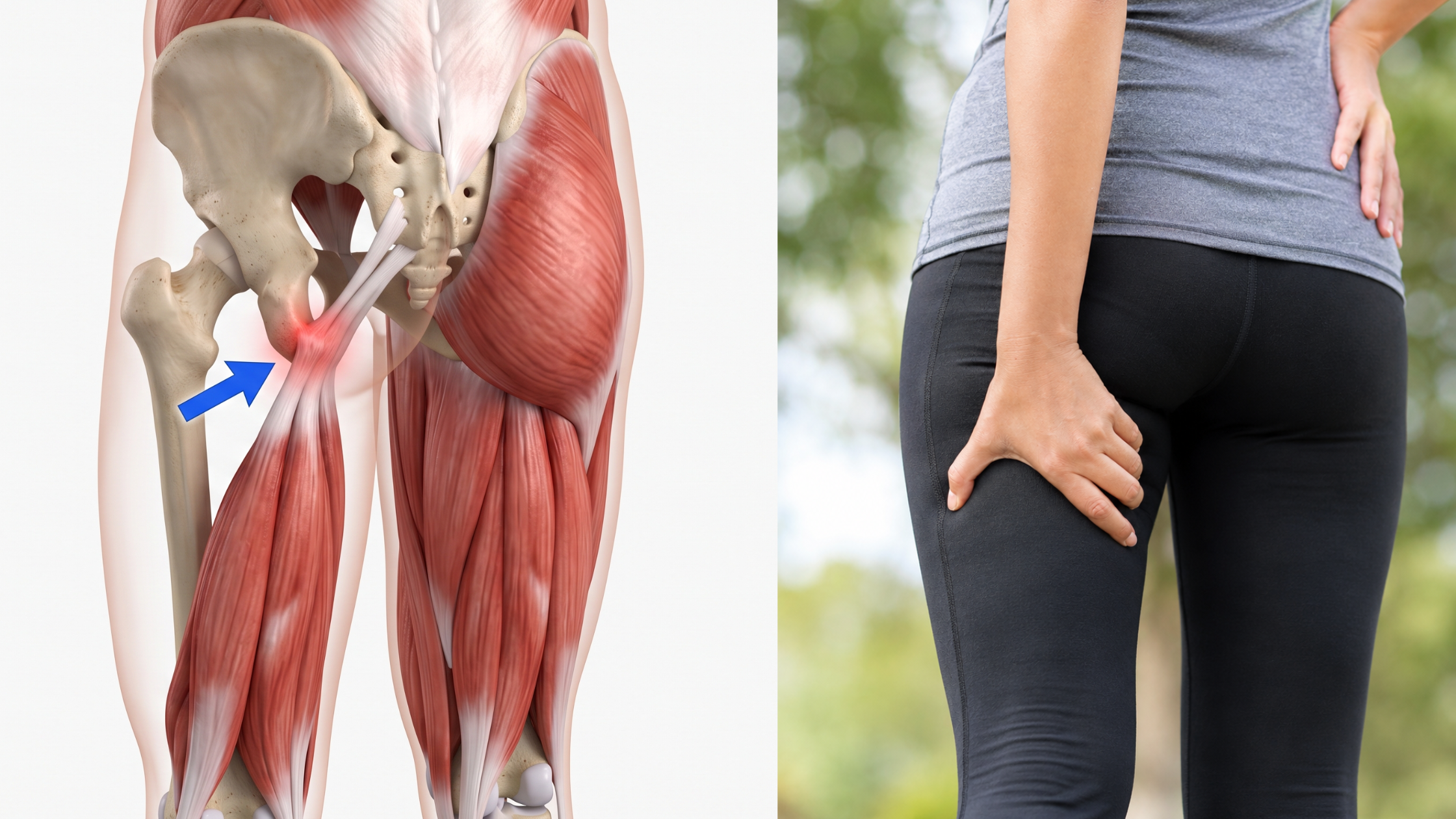
If you're getting confused between a tendon and a ligament, here's a quick anatomy lesson. A tendon connects muscle to bone, while a ligament connects bone to bone. Although both are made of strong connective tissue, they are designed for stability rather than flexibility. Tendons can tolerate a tremendous amount of force, but they don't like being repeatedly overloaded. When a tendon is subjected to excessive stress over time, it can become irritated and painful—a condition known as tendinopathy. That's exactly what happens in Yoga Butt.
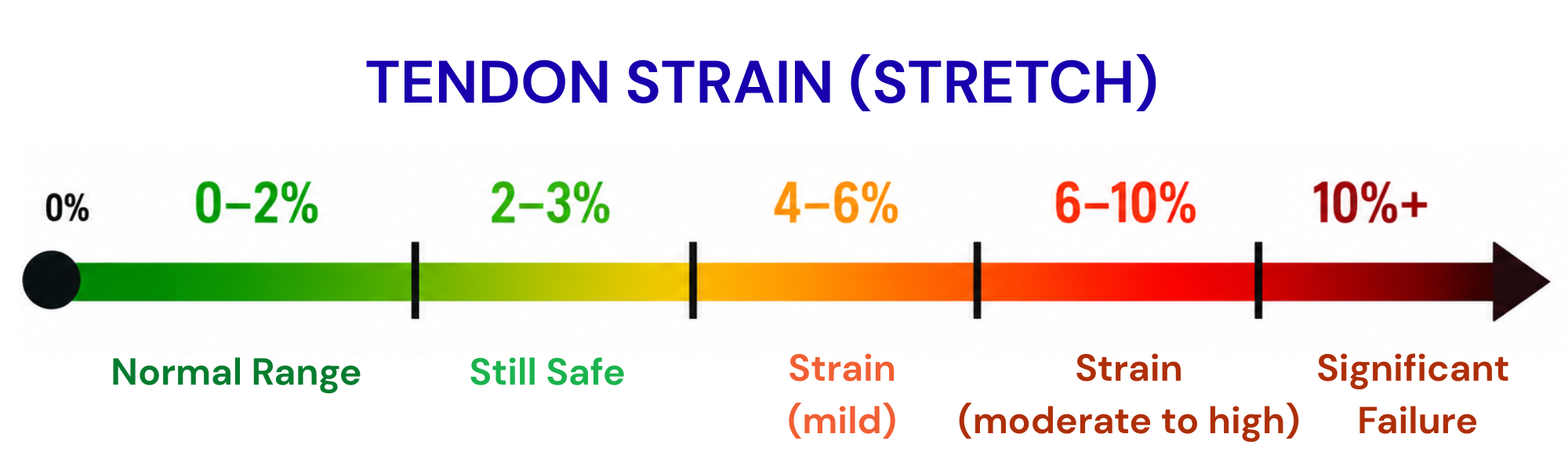
One interesting thing about tendons is that they have a very limited ability to stretch. Unlike muscles, tendons are designed to transmit force, not to become highly flexible. If you look at the diagram above, you'll notice that a tendon can safely stretch by about 0–2% of its length under normal loading. As the strain increases to around 4–6%, microscopic damage to the collagen fibres can begin. Beyond that, the risk of injury increases significantly, and strains of 8–10% or more can lead to partial or even complete tendon rupture. Recovering from such an injury can take several months and, in severe cases, may even require surgery.
The good news is that this is not what usually happens during Yoga practice. In most cases, the hamstring tendon is loaded to only about 3–5% of its capacity. The problem isn't the amount of stretch—it's the repetition. Repeatedly forcing yourself into deep forward folds without giving the tendon enough time to recover gradually overloads the tissue. Over weeks or months, this repetitive stress can lead to proximal hamstring tendinopathy, commonly known as Yoga Butt.
This often presents as a deep ache around the sitting bone, where the hamstring tendon attaches to the pelvis. Some people may also experience pain that radiates into the back of the thigh or is even felt in the lower back. That's why pain doesn't always appear immediately after a single stretch—it develops gradually as the tendon's ability to recover is exceeded.
How to Self-Test for Proximal Hamstring Tendinopathy
If you suspect you have proximal hamstring tendinopathy (also known as Yoga Butt), these two simple self-checks can help you determine whether your symptoms are consistent with the condition. While these tests cannot confirm a diagnosis, they can help you decide whether it's time to seek professional assessment.
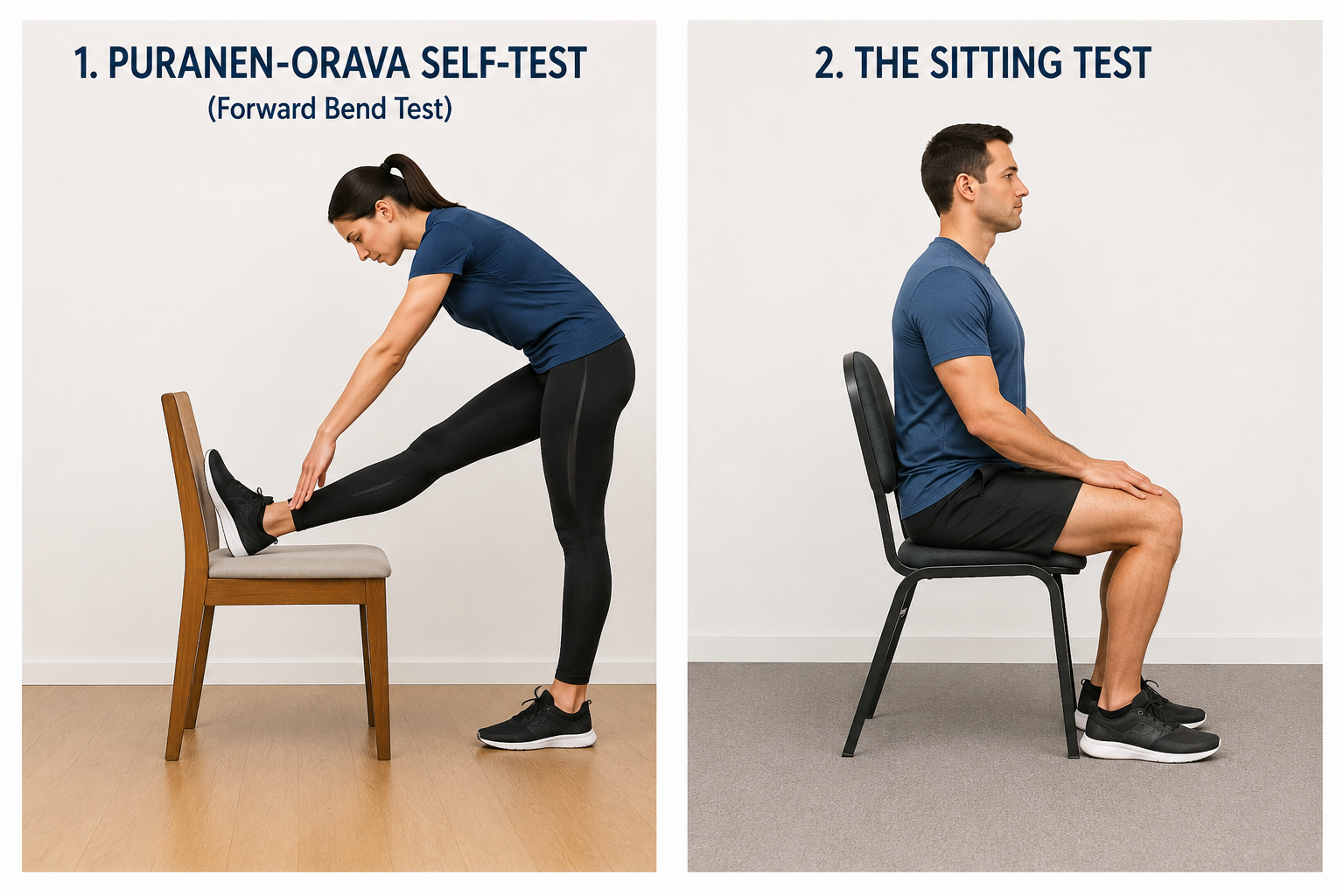
1. Puranen-Orava Self-Test
The Puranen-Orava Test is commonly used by healthcare professionals to assess proximal hamstring tendinopathy.
How to perform the test:
Stand in front of a chair or sturdy table.
Place the affected leg on the chair with your hip bent to approximately 90°.
Keep your knee completely straight.
Slowly hinge forward from your hips until you feel a stretch in the back of your thigh.
Positive result:
The test is considered positive if it reproduces your familiar pain deep in the buttock or directly over the sitting bone (ischial tuberosity). A normal stretching sensation or hamstring tightness is not considered a positive result.
2. The Sitting Test
One of the most characteristic symptoms of proximal hamstring tendinopathy is pain while sitting.
How to perform the test:
You probably already have an idea whether this test is positive because most of us spend a good part of the day sitting on a chair while working, driving, or watching TV. If you notice pain around your sitting bone after sitting for a long time, it may be a sign of proximal hamstring tendinopathy.
If you don't have a desk job or don't usually sit for long periods, sit on a firm chair for 20–30 minutes in your normal posture. Pay close attention to how the area around your sitting bone feels. If you develop pain or a deep ache that improves when you stand up or walk around, the test may be considered positive.
Positive result:
You may have proximal hamstring tendinopathy if you notice:
Pain directly over the sitting bone.
A deep ache in the lower buttock or upper hamstring.
Pain that improves when you stand up or walk around.
What Do Your Results Mean?
If both of these self-tests reproduce your typical symptoms, there is a higher likelihood that your pain is coming from the proximal hamstring tendon. However, these tests cannot diagnose the condition on their own. Similar symptoms may also occur with hamstring strains, lower back problems, or other hip conditions.
If your symptoms persist for more than a few weeks, worsen with activity, or interfere with your daily life, consult a qualified healthcare professional for a comprehensive assessment and appropriate treatment.
How to Fix Yoga Butt (Proximal Hamstring Tendinopathy)
So, how do you fix Yoga Butt, or proximal hamstring tendinopathy?
Interestingly, when most people develop this condition, they don't even realize what's going on. Their immediate reaction is, "My hamstrings are tight." And to be fair, we've all heard that hamstrings are always tight. So they do what seems logical—they stretch them even more. Unfortunately, in the case of Yoga Butt, that's often the worst thing you can do because it places even more stress on an already irritated tendon.
If your pain is located deep around the sitting bone and sometimes radiates into the back of the thigh or even the lower back, there's a good chance you're dealing with proximal hamstring tendinopathy rather than simple muscle tightness. In that case, the treatment needs to match the problem.
The goal is not to stretch the hamstrings further. Instead, we need to reduce irritation, gradually strengthen the hamstring tendon, and restore its ability to tolerate load. Once the tendon becomes stronger and less sensitive, you can gradually return to deeper forward folds without provoking pain.
Here are some of my favourite Yoga Asana to help you build strength, support tendon recovery, and safely return to your practice :


