Is There Still Demand for Yoga Teachers? Everything You Should Know Before Enrolling in a Yoga Teacher Training Course
Teaching yoga is considered one of the top 10 preferred professions in the USA. The fact that the industry is growing at a rate of 9% CAGR, with a market size of around $130 billion in 2026 expected to grow to $269 billion by 2030, indicates that the industry could almost double in size over the coming years.
These are certainly impressive numbers. They impressed me as well when I first came across them. But does that automatically make yoga a good career choice?
Well, these numbers alone do not give a clear picture, and here's why.
Why Market Size Doesn't Tell the Whole Story
In my opinion, one of the biggest factors that determines whether an industry becomes saturated is its Barrier to Entry. Simply put, the barrier to entry is the amount of time, money, & effort required to enter a profession. The lower the barrier to entry, the easier it becomes for more people to join.
Let's understand this with a simple example.
Imagine Coldplay announces a concert and says that entry to the stadium is completely free. How many people do you think would turn up for that event? The number would likely be in thousands. But the moment they put a price tag on the tickets, the number of people attending would reduce. As the cost of entry increases, fewer people are able to participate.
The same principle applies to professions. When the cost, time, and effort required to enter a profession are low, more people are likely to join. And when more people enter the same space, competition naturally increases.

Why the Barrier to Entry in Yoga Is Low
You can become a yoga teacher with an investment of as little as $200 (INR 20,000) by enrolling in a Yoga TTC. In many parts of the world, the yoga teaching profession is also not strictly regulated, which means people can enter the profession through different pathways (even by learning on Youtube) and not everyone is certified by accredited schools. I know several people who have been teaching yoga for years without any formal yoga education or certification.
Now imagine the number of people who can enter this profession when the barrier to entry is so low. When a career requires less time, financial investment, and formal qualifications, it naturally attracts more people.
This is also one of the reasons why yoga teaching has become such a popular second career choice. Many people transition into yoga after spending years in another profession. You'll often hear stories like, "I worked in the corporate world before becoming a yoga teacher," or "I left my job to pursue yoga full-time."
In contrast, it is less common to hear an 18-year-old say, "I want to become a yoga teacher." For many, yoga becomes a profession they choose later in life, once they are looking for a more meaningful career or a better work-life balance.
And once again, the reason is simple—the barrier to entry is relatively low, making it much easier to switch into yoga than into many other professions.
Now compare this with professions such as engineering or software development. The barrier to entry is significantly higher. You may need several years of formal education or dedicated learning before you are ready to enter the professional world, and even then, many people start at entry-level positions while continuing to build their skills.
The same applies to professions such as medicine, engineering, and many other specialized fields where years of education, training, and qualification are required before someone can begin practising.
The Race to the Bottom
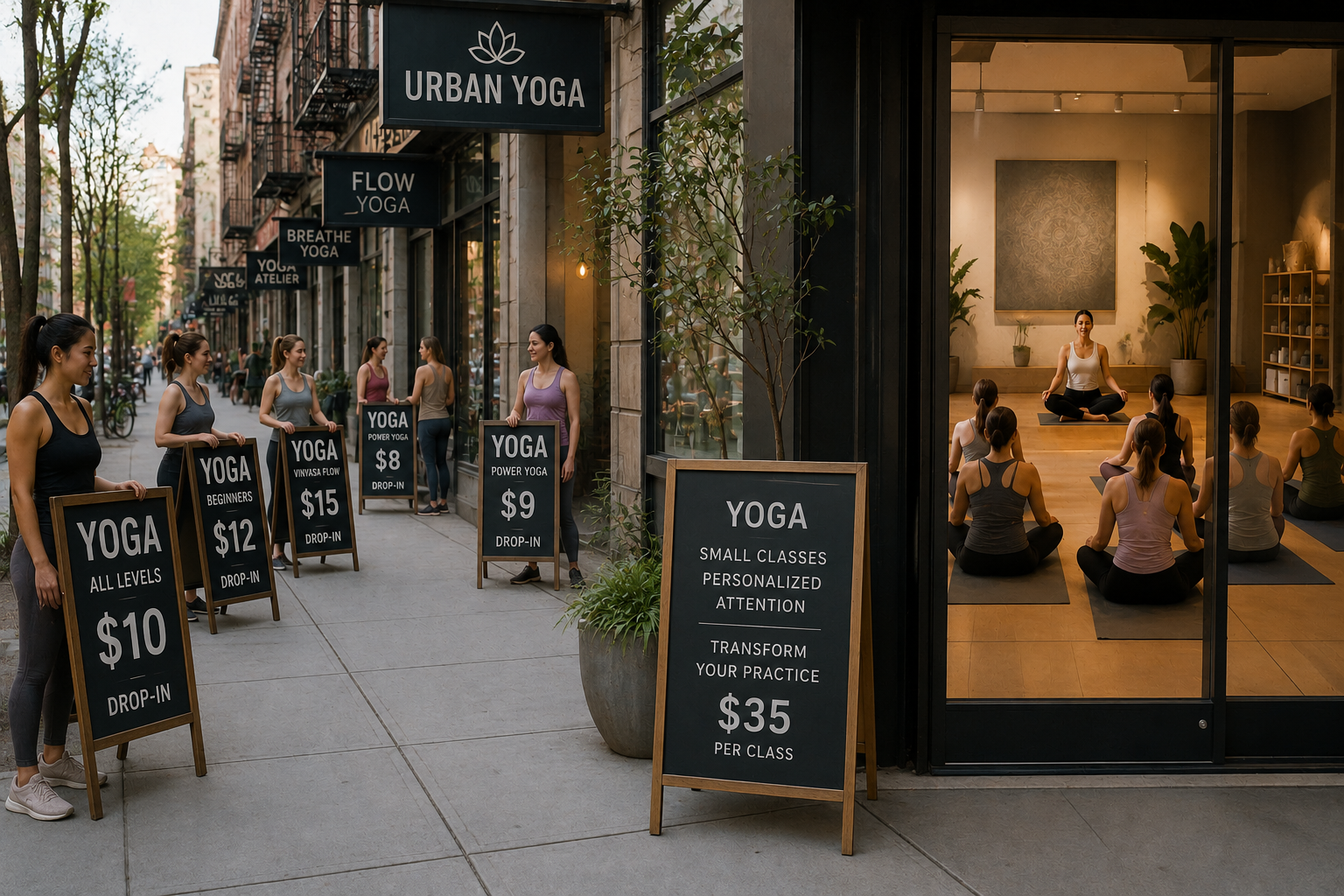
All of this leads to something I call the race to the bottom.
Since so many people are entering the yoga profession, the supply of yoga teachers often grows faster than the demand for yoga classes. In some parts of the world, it feels as though there is a yoga studio on every corner, and almost everyone has completed a Yoga Teacher Training course.
As competition increases, many teachers find themselves competing on price rather than value. Some are willing to charge very little for their classes, while others even teach for free to gain experience, attract students, or build their reputation.
That is why you often hear yoga teachers say, "I struggle to manage my expenses," or "I don't earn enough despite teaching yoga."
Interestingly, this happens even though the overall yoga industry is growing and the market size numbers look impressive. A growing industry does not automatically guarantee that everyone working in it will earn well.
Is the Yoga Industry Really Saturated?
Does this mean that yoga is not a suitable profession or that the yoga industry is completely saturated?
Not exactly.
Yes, the yoga industry is highly competitive at the entry level, where many teachers have similar qualifications and compete for the same opportunities. But if you develop deeper skills, gain experience, and learn how to solve real problems for your students, you move beyond this crowded space.
You move towards the upper level of the profession, where teachers are valued differently and can command much higher fees.
One thing that many people fail to notice is the huge gap between experienced, skilled teachers and those who are just starting out or have limited expertise. The difference in their earning potential can be significant.
In yoga, as in any profession, the market does not reward everyone equally. The people who continue learning, build expertise, and create better outcomes for their students are the ones who are able to differentiate themselves and earn more.
Your Biggest Competitive Advantage: SKILL

So, the number one priority should always be developing your skills.
When you decide to take up a Yoga Teacher Training course, give yourself enough time—at least six months—to truly understand and absorb the fundamentals.
What usually happens is that people enroll in a course, spend 30 days at a yoga school, and suddenly their entire routine changes. They wake up early, follow a completely different lifestyle, practise intensively, and receive a huge amount of information within a very short period.
While this experience can be transformative, it can also become overwhelming, especially for beginners. Trying to absorb philosophy, anatomy, teaching methodology, alignment, sequencing, and other concepts all at once is a lot to process.
A 30-day training can provide you with a foundation, but developing confidence and real teaching skills requires time, practice, and continued learning beyond the certification.
My Experience as a Yoga Teacher Trainer
I say this from my own experience because I have conducted Yoga Teacher Training courses myself.
Over the years, we have learned that developing confidence as a yoga teacher takes time. We always encourage our students to continue practising and learning long after their training has ended. We have also conducted teacher training programmes spread over two months, and even through that experience, we realized that while students gain knowledge and understanding during the course, true confidence develops only through consistent practice, teaching, and time.
That is why we continue to support our students through mentorship and an active learning community, even after they complete their certification. Learning doesn't stop when the course ends it is only the beginning of the journey.
Becoming a skilled yoga teacher is not just about completing a certification. It is about giving yourself enough time to absorb the knowledge, apply it, make mistakes, learn from them, and gradually develop the confidence to guide others.
If you aspire to become a yoga teacher, my advice is to first build a strong foundation in the fundamentals of yoga—asana, pranayama, anatomy, and philosophy—before enrolling in a 200, 300, or 500-hour Yoga Teacher Training course. Having this foundation will help you understand the concepts more deeply, get far more out of your training, and ultimately become a more confident and capable teacher.


